
Affordable AI Writing Assistants With Real Privacy
I pasted a client contract into an AI rewriter, watched it come back cleaner, and then spent forty minutes reading the policy to find out what had just happened to it. The answer was in a retention clause three pages down: kept for a month, accessible to staff for abuse review. Nothing shady, nothing hidden. I just hadn't checked before I pasted.
That's the whole problem with privacy in this category. The information is public and nobody reads it, so people pick tools on price and find out later.

Type Mac is what I settled on after that. More on why at the end. The checklist matters more than my pick.
The four questions that actually decide this
Everything else is marketing. Ask these:
- Is my text retained, and for how long? Zero retention, 30 days, and indefinite are three completely different products.
- Can a human read it, and under what conditions? Abuse review, support access, and quality sampling are all humans, and they're all normal.
- Is it used for training, and is opting out on by default? A buried checkbox that defaults to on is a different answer than a policy that says never.
- How many companies touch it on the way to the model? This is the one nobody asks, and it's the one that compounds.
Where the answers live
Not the landing page. The landing page says "enterprise-grade security," which is a statement about encryption in transit and tells you nothing about who reads your drafts.
Go to the privacy policy and search for "retention" and "human." Then check whether the terms you're reading apply to the tier you're on. Consumer plans routinely carry weaker terms than the enterprise plan of the same product, and the trust page usually describes the enterprise one. If the vendor publishes a DPA, that's the document with real commitments in it.
Budget ten minutes per tool. It's less time than you'll spend comparing their feature tables.
Every hop is another policy to trust
Here's the structural thing that took me too long to see.
When you use a wrapper app, meaning anything that takes your text, sends it to its own backend, and forwards it to OpenAI or Anthropic, you are now trusting two privacy policies instead of one. The model provider's, and the wrapper's. The wrapper is usually a smaller company with a shorter policy, less legal scrutiny, and a stronger incentive to keep your text around for debugging.
Most AI writing apps work exactly this way, and almost none of them say so on the pricing page. You find it in the architecture section of the docs, if it's documented at all.
Fewer hops, fewer policies. That's the entire privacy argument, and it's more useful than any badge on a homepage.
"No human review" is almost never absolute
Treat an unconditional promise as a reason to check harder, not to relax.
Abuse detection needs some path to flagged content. Support needs some way to reproduce your bug. Legal process exists. A serious vendor writes down the narrow conditions under which a person can see your text and what's logged when they do. A vendor claiming literally nobody can ever see anything is either running fully on-device or hasn't thought it through.
What you want is a small, specific list of exceptions, not the absence of one.
Local models are the ceiling, and you'll feel the tradeoff
If the text genuinely cannot leave your machine (patient notes, sealed filings, unreleased financials), run the model locally. Ollama and LM Studio make this a twenty-minute setup on Apple Silicon, and nothing touches the network.
The tradeoff is real. A model small enough to run on your laptop writes noticeably worse than the frontier ones, it costs you RAM you wanted for actual work, and you maintain it yourself. For the top-secret 5% of what you write, that's a fine trade. For the other 95% it's a lot of friction to protect a Slack message.
Privacy shouldn't be the enterprise tier
The annoying pattern in this category: the free plan trains on your text, the mid plan doesn't say, and the plan with real data commitments starts at a seat price with a sales call attached.
There's a cheaper route. Bring your own API key, pay the provider directly per request, and you get the provider's API terms, which are generally stricter about training than their consumer chat terms, at a fraction of a cent per rewrite. You see the actual bill. Mixing providers by task keeps it there.
Privacy as a $30/seat upsell is a pricing decision, not a technical one.
The setup I trust with client work
Type Mac, with my own API key in it.
The reason is the hop count, not a feature. With my own key in it, the text goes from my Mac straight to the provider I picked: OpenAI, Anthropic, Google, or Groq. It isn't routed through an intermediary's backend, stored there, or used to train anything belonging to the app. So I read one privacy policy, the one belonging to the provider I chose, and I'm done. Every wrapper app I tried first added a second policy on top of that one.
Two honest limits. It isn't offline. Your text still reaches whichever provider you picked, and their retention terms are still their terms, so choose deliberately. And it's Mac only, which does nothing for you on a work Windows machine.
For everything short of genuinely sealed material, one policy instead of two, at a fraction of a cent per edit, is the trade I'd make again. If your work is the sealed kind, run a local model and accept the quality hit.
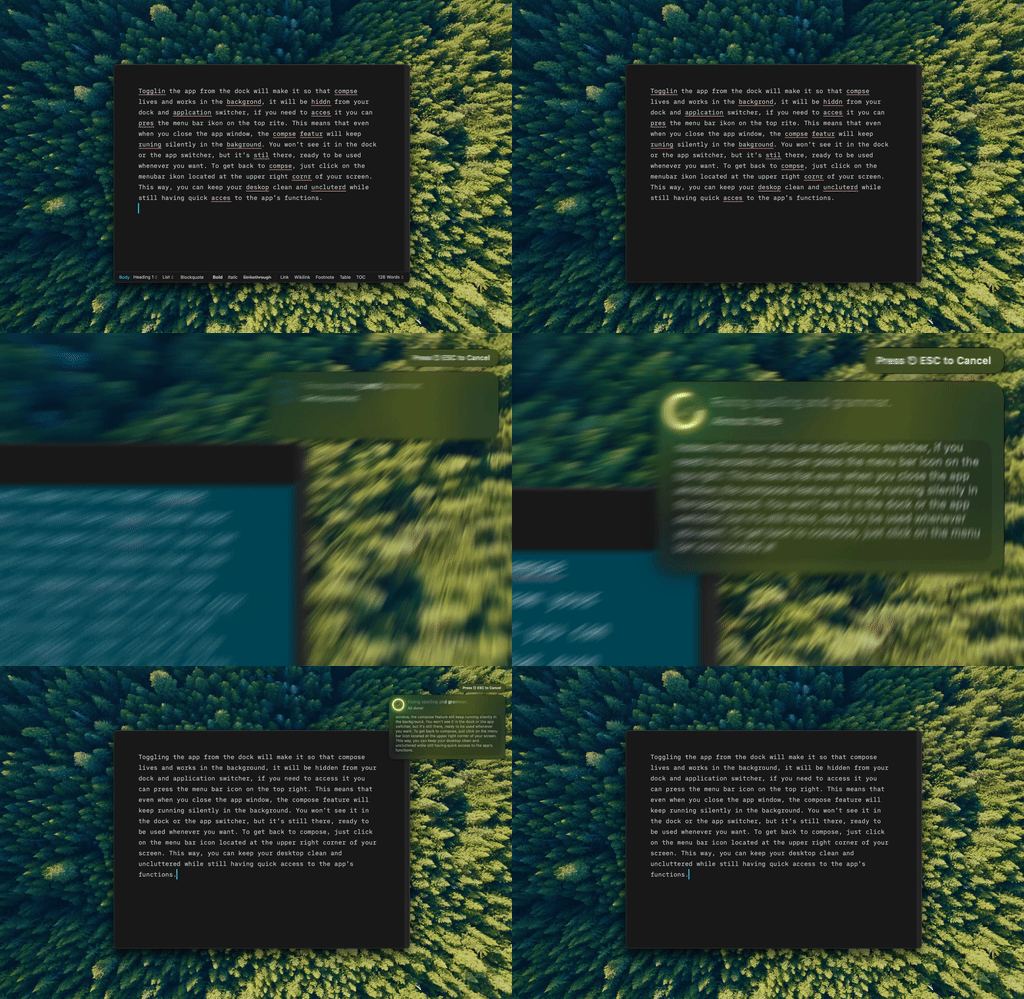
The version of this that failed for me was the copy-paste loop: draft in one app, paste into a chat window, paste back. Every one of those pastes was a decision about someone's privacy policy, made in a hurry, forty times a day. Fixing text where it already lives removed the decision.
Read one privacy policy instead of two. Type Mac sends your text straight to the provider you choose, at under $20 for a year of it.