
How to Sound More Native in English Writing (10 Fixes)
How to sound more native in English comes down to patterns, not vocabulary. Native writers use contractions, phrasal verbs, short sentences, and verbs instead of heavy nouns. Writers who avoid these sound formal or translated, even with perfect grammar.
Below are 10 patterns, each with a before and after. Apply two or three to your next email and the difference shows at once.
Correct is not the same as natural
"I am writing to inform you that the meeting has been postponed to a later date" has no errors. A native colleague would write "Heads up: we moved the meeting. New date to follow." Both are correct. Only one sounds like a person at work.
If your sentences still have grammar errors, fix those first with how to correct an English sentence. This post is the next layer.
How to sound more native in English: 10 patterns
1. Use contractions
- Before: "I am not able to attend. I will send you my notes."
- After: "I can't make it. I'll send you my notes."
In emails and chat, native writers use "I'm," "it's," "don't," and "we'll." Full forms read as formal or cold. Keep full forms for contracts and formal reports.
2. Use phrasal verbs for everyday actions
- Before: "We will investigate the issue and contact you."
- After: "We'll look into it and get back to you."
Phrasal verbs such as "look into," "set up," "follow up," "figure out," and "go ahead" are the default in spoken and casual written English. Latin verbs such as "investigate" and "commence" sound like a manual.
3. Write shorter sentences
- Before: "Regarding the project, which as you know has been delayed due to several factors including the budget, I would like to propose that we have a call in order to discuss the next steps."
- After: "The project is late, mainly because of the budget. Can we have a call to plan the next steps?"
Put one idea in each sentence. As a guide, keep most sentences under 20 words.
4. Use verbs, not heavy nouns
- Before: "We made a decision to carry out an analysis of the data."
- After: "We decided to analyze the data."
"Make a decision," "carry out an analysis," and "give an explanation" hide the verb inside a noun. Pull it out: "decide," "analyze," "explain."
5. Use the natural word pairs
| Translated | Natural |
|---|---|
| "do a mistake" | "make a mistake" |
| "make a photo" | "take a photo" |
| "say a joke" | "tell a joke" |
| "strong rain" | "heavy rain" |
| "high traffic on the road" | "heavy traffic" |
These pairs, called collocations, have no rule. Learn them as one unit, the way you learn a single word.
6. Drop the translated formulas
- Before: "Kindly do the needful and revert at the earliest."
- After: "Could you take care of this and reply by Friday?"
- Before: "Please find attached the document."
- After: "I've attached the document."
Formulas that look polite in one language can sound stiff or old in English. Plain words are the polite choice in modern English email.
7. Put adverbs where native writers put them
- Before: "I like very much this idea."
- After: "I really like this idea."
- Before: "I always am on time."
- After: "I'm always on time."
In English, the object follows the verb directly. "Always," "never," and "often" go before the main verb but after "am," "is," and "are."
8. Make requests the English way
- Before: "I want the updated file today."
- After: "Could you send me the updated file today?"
Many languages state a request directly. English softens it with "could you," "can you," or "would you mind." The direct form reads as rude to many native readers, even when you mean it neutral.
9. Prefer the active voice
- Before: "The bug was fixed by our team and the release was approved by the client."
- After: "Our team fixed the bug, and the client approved the release."
The active voice is shorter and tells the reader who did what. Use the passive only when the actor does not matter.
10. Use names the way native speakers do
- Before: "Dear Mr. John,"
- After: "Hi John," or "Dear Mr. Smith,"
"Mr." goes with the family name, never the first name. In most work email, "Hi" plus the first name is normal, even with people you have not met.
How to write English like a native speaker every day
Patterns stick when you use them. Four habits help:
- Collect phrases. When a native colleague writes a sentence you like, save it to a note. Reuse it next week.
- Rewrite one message a day. Take one email you sent and rewrite it with the 10 patterns above.
- Compare versions. Put your draft next to a native version and name each difference. Each difference is a pattern you can reuse.
- Read it aloud. If a sentence is hard to say in one breath, split it.
Skip forced idioms. "It's raining cats and dogs" in a work email sounds less native, not more.
Practice every day with Type Mac
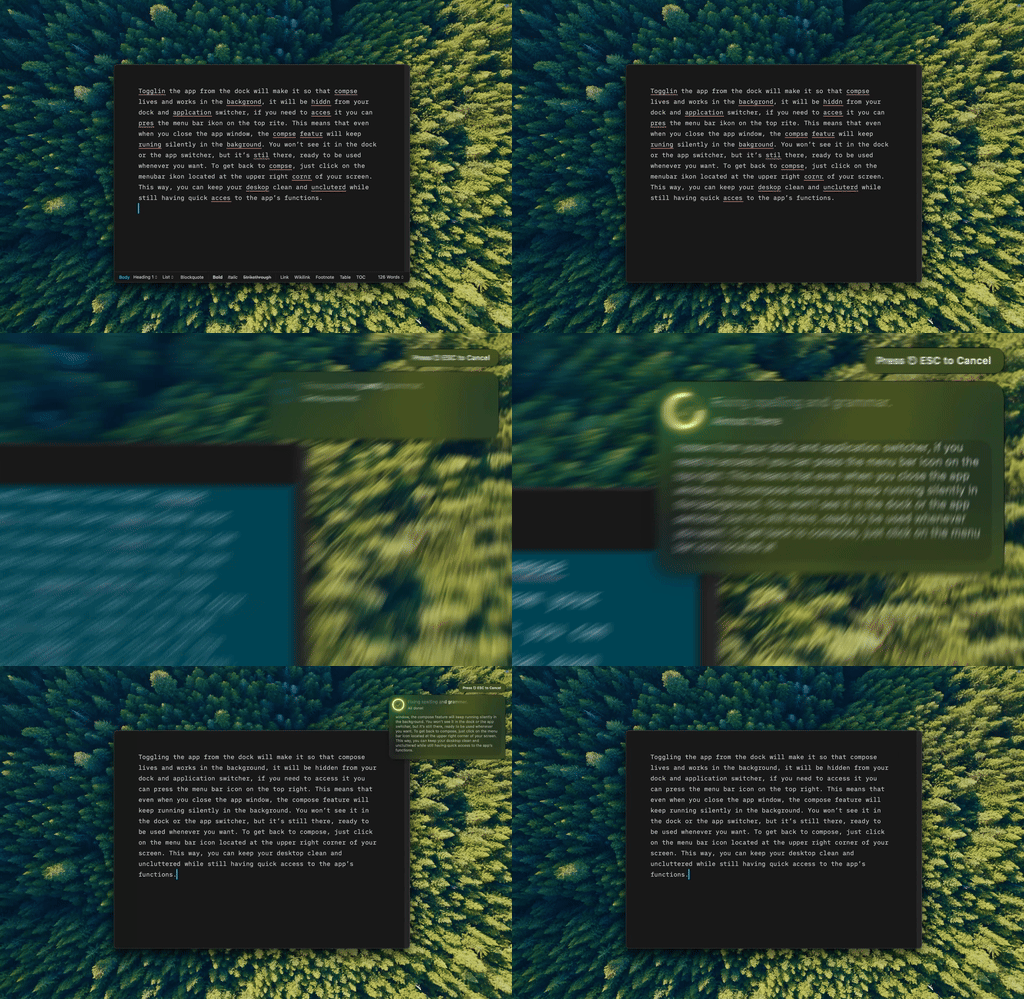
Type Mac: select your draft, press one shortcut, and the natural English version replaces it in place.
You learn these patterns faster when you see them applied to your own sentences, many times a day. Type Mac is a Mac menu bar app that rewrites selected text in place, in Mail, Slack, Notes, browsers, and other apps where you can select text.
- Add a custom shortcut with the prompt: "Rewrite this in natural, native English. Keep my meaning and keep it short."
- Write your message the way it comes to you.
- Select it and press the shortcut.
- Before you send, read what changed. Each change is one of the patterns above, on your own words.
For grammar errors, the built-in Fix Writing shortcut, Command-Shift-Return, corrects the sentence and keeps your wording. Type Mac also remembers how you write: add your role and the tone you want, and each rewrite fits them.
This turns 30 daily messages into 30 small lessons, with no extra study time. Plans cost $4.99 a month, or $49.99 a year with a 7-day free trial. For more tools, read AI tools for non-native English speakers and how to keep your voice with AI writing tools. The write better English on Mac page shows the app.
FAQ
How can I make my English sound more natural fast?
Use contractions, replace formal verbs with phrasal verbs, and split long sentences. These three changes have the biggest effect on email and chat.
Do I need idioms to sound native in writing?
No. Native writers use few idioms in work writing. Phrasal verbs, natural word pairs, and short sentences matter more.
Is it wrong to use AI to improve my written English?
No. Use it like a native colleague who reviews your draft. Read each change and reuse the pattern, so your own first drafts improve.
Should I write in American or British English?
Match your readers, and stay consistent in one document. The patterns in this post work in both.
Sound like yourself, in natural English. Type Mac rewrites your draft in any Mac app, and you learn from each change.